
Showing energy doesn't flow along the electric field or along the magnetic field. It flows perpendicular to both, which is exactly what the cross product (×) captures mathematically.
This is the revelation: energy flows through the electromagnetic field in the space surrounding the wire. But it doesn't just flow past the conductor but couples into it such that field configuration creates an electric field inside the wire, and that's what actually moves the electrons.
The copper wire isn't a pipe carrying energy. It's a guide that shapes the electromagnetic field in space and carrying energy outside, directing electrons inside.
But a wave, once launched, doesn't need anyone to keep pushing it. Light from a star still travels long after the star itself is gone.
Because this loop, E creating B, B creating E, isn't launched once and left alone. Something has to keep feeding it. Something has to keep the imbalance from collapsing.
[refer to battery’s role]
So, when you flip the switch and the circuit closes, all of this happens at once.
The electromagnetic field restructures itself throughout the circuit. The Poynting vector springs into existence, mapping how energy moves through space. An internal electric field emerges inside the wire. Electrons begin drifting, in one direction, together.
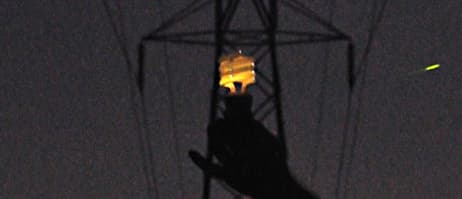
Energy flows outside the wire, carried by the field through empty space. Current flows inside the wire, guided by that same field. At the bulb, the two converge — energy absorbed, current delivered, light produced.
Without the wire: the field propagates, but there are no charges to do work.
Without the field: the wire sits inert, charges with no instructions.
Together: the battery maintains the imbalance, the field carries the energy through space and directs the current, the wire hosts the charges and shapes the field's geometry and electrons drift, quietly, to deliver power to the bulb.